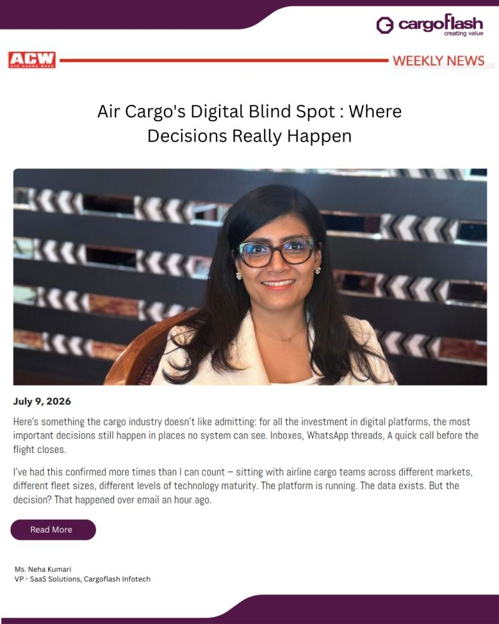
Despite significant investments in digital platforms, many critical decisions in air cargo operations continue to take place outside formal systems. From email exchanges and instant messages to urgent phone calls, the gap between digital records and real-time decision-making remains a challenge for the industry.
The Gap Between Digital Systems and Actual Decisions
Air cargo operations have increasingly adopted digital platforms to manage bookings, rates, capacity and shipment information. However, many important operational decisions still happen through emails, WhatsApp conversations and phone calls.
Booking requests, rate confirmations, change requests, offload updates and escalations often continue to be managed through email exchanges. As a result, the inbox can hold a more complete account of a shipment's journey than the actual cargo management system.
This becomes particularly significant when handling time-sensitive shipments such as pharmaceuticals, aircraft-on-ground (AOG) parts and live animals, where timely decisions and coordination are essential.
When Temporary Workarounds Become Operational Processes
Email continues to play an important role in cargo operations, not necessarily because it is the most suitable tool, but because it fills gaps that existing platforms have not fully addressed.
Exceptions, commercial negotiations and urgent coordination, particularly during disruptions, often require teams to rely on familiar communication channels.
However, what begins as a temporary workaround can gradually become a permanent part of the operational process. Critical decisions involving pricing, capacity and disruption management continue to depend on manual coordination, even as the pace of the cargo business increases.
The Missing Metric in Cargo Operations
Airlines regularly monitor performance indicators such as load factor, yield and revenue per available tonne-kilometre (ATK). However, the time taken to make operational decisions often receives less attention.
How quickly are customers informed about a capacity change? How long does it take to develop a recovery plan for an offloaded shipment?
When decisions depend on lengthy email chains and manual coordination, delays can become normalised. These inefficiencies may not always appear on conventional performance dashboards, but they can have a significant operational and commercial impact.
Moving Beyond Transaction Recording
Cargo management systems have traditionally been designed to record transactions such as bookings, manifests, invoices, weight and piece counts. While these functions remain essential, modern cargo operations require more than transaction management.
Teams make numerous time-sensitive decisions every day, including allocating the last available belly cargo space, approving rates based on changing load conditions and communicating shipment delays to customers.
The challenge is therefore not simply about storing operational information. Systems must also support the decisions that determine how cargo operations move forward.
The Need for Clearer Digital Direction
The availability of multiple technology vendors and specialised solutions has not necessarily addressed the underlying challenges faced by cargo teams. Different systems often solve individual parts of the process without providing a coordinated approach.
The priority should be to identify where decisions are breaking down before investing in additional technology.
A more effective digital transformation approach requires attention to the decision-making layer — where rates are approved, capacity is allocated and customers are informed about shipment disruptions.
Ultimately, the next phase of air cargo digitalisation must go beyond recording transactions. It must connect information, communication and operational decisions to create more responsive and efficient cargo operations.
………………………………………………………………………………………………………………………………
ABOUT CARGOFLASH: CargoFlash Infotech has been a trailblazer in digitalising Air Cargo management since 2009. Our technology and business solutions cater to the global Air Cargo ecosystem. Headquartered in Delhi NCR, our end-to-end solutions prioritise accessibility, transparency and reliability, effectively streamlining cargo operations. For more information on our products and services, visit www.cargoflash.com.
For further details or queries, contact:
Sonali Sharma
Marketing, CargoFlash Infotech
sonali.sharma@cargoflash.com
+91 97181 39154
Read more:
Air Cargo’s Digital Blind Spot: Where Decisions Really Happen - Air Cargo Week